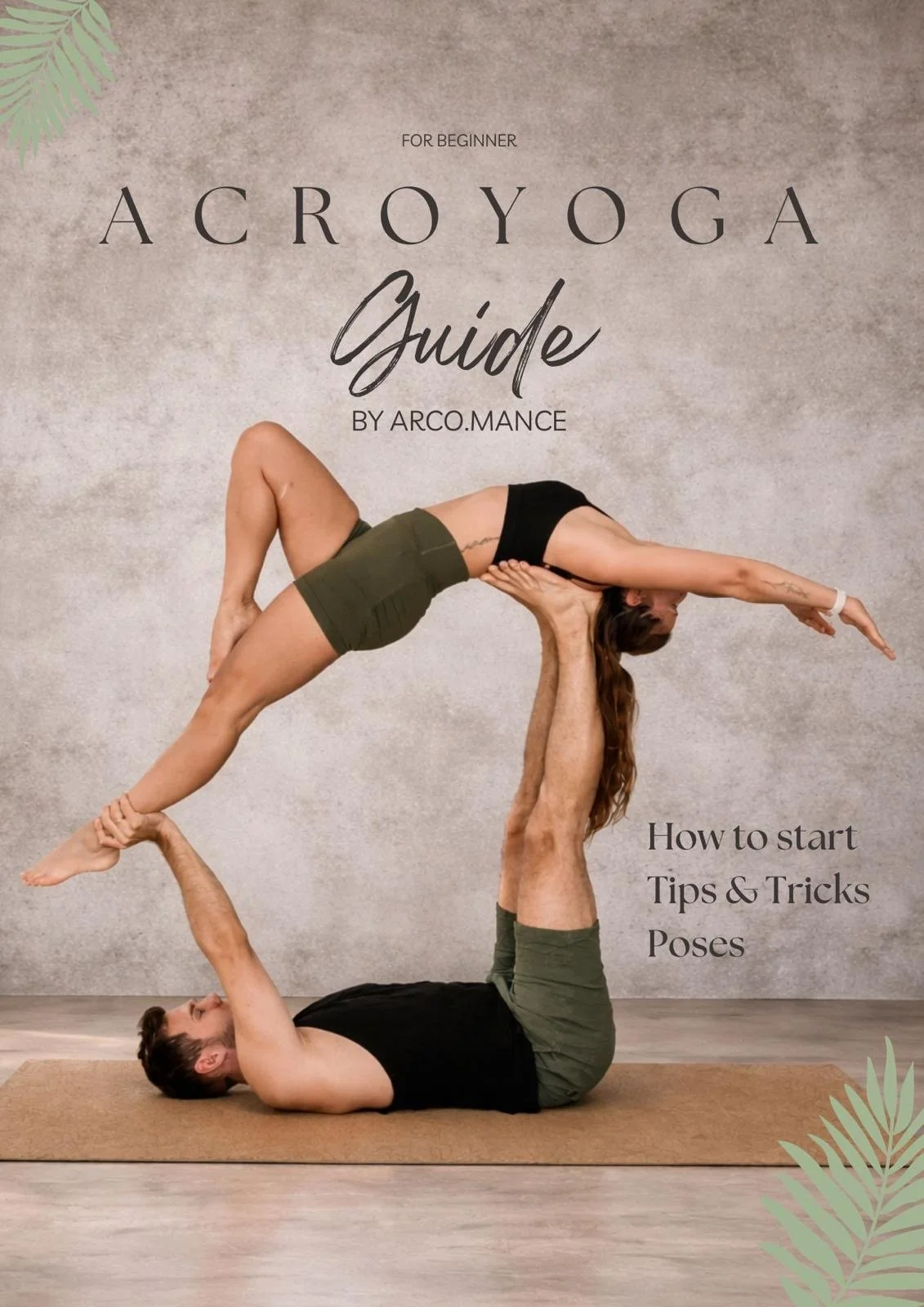
Start your Acro Journey here!
Dreaming of flying, basing, and flowing together?
This Beginner AcroYoga Guide is the perfect starting point for new Acro practitioners. Through 12 easy-to-follow video lessons, you'll learn the fundamental poses and transitions that form the foundation of AcroYoga.
Master 10 beginner-friendly poses, connect them through 2 guided flows, and put your new skills to the test with an exclusive Advanced Beginner Bonus Flow.
No guesswork, no overwhelm—just a clear path to building confidence, trust, and solid Acro fundamentals.
BEFORE YOU START:
The foundation that comes before all poses
Most incidents don't happen because of poses being too difficult, but due to missing communication, skipped warm-up, or the pressure to prove something. Communication is not optional – it is an integral part of the practice. In AcroYoga, clear signals, honest feedback, and the willingness to say 'stop' are just as important as strength and balance. In fact, a duo that communicates well is always safer than a stronger duo that stays silent.
Acroyoga involves physical activity and carries a risk of injury.
By participating, you do so at your own risk and are responsible for your own safety.
We are not liable for any injuries or damages resulting from participation in this course.
1. Warm Up Together
At least 10 to 15 minutes before the first pose. Circle wrists, mobilize shoulders, warm up hips, prepare the spine. Sun salutations as a team are ideal – they bring both partners into the same rhythm and create shared body presence.
2. Agree on Clear Signals
Before starting, explicitly establish what 'stop', 'wait', 'I'm ready' and 'come down' mean. Simple, unambiguous words with no room for interpretation. These signals should be repeated in every session until they become automatic.
3. Spotter for New Poses
Every pose you try for the first time deserves a Spotter. Even if you feel confident. The Spotter stands to the side, initially holds the Flyer's hips and only steps back once the pose is stable. Spotters don't need to be experts – being attentive and present is enough.
4. Soft Surface
Always practice on a thick yoga mat or gymnastics mat. Ideally, additional mats on the sides as 'landing zones'. Hard floors, carpets, or grass significantly increase the risk of injury.
5. Respect Progression
This handbook presents five poses in a deliberate sequence. Don't skip any. Each pose prepares you physiologically and psychologically for the next. Those who skip step three to reach step five pay the price sooner or later.
6. Listen to Your Body
Pain is not a sign of strength – it is a clear stop signal. Discomfort, numbness, tingling, or pressure in the wrong place: communicate immediately and come down. AcroYoga should feel good – if it doesn't, something isn't right.
7. Ego-Free Zone
One of the most important invisible safety measures. Bring no expectations to the mat, no must-achieve-this-today' energy. AcroYoga is a practice – it has no goal other than the present moment.
8. Cool Down and Reflection
After the session, come together briefly: What worked well? What was difficult? Thank each other.
This ritual strengthens trust and helps you start better next time.!